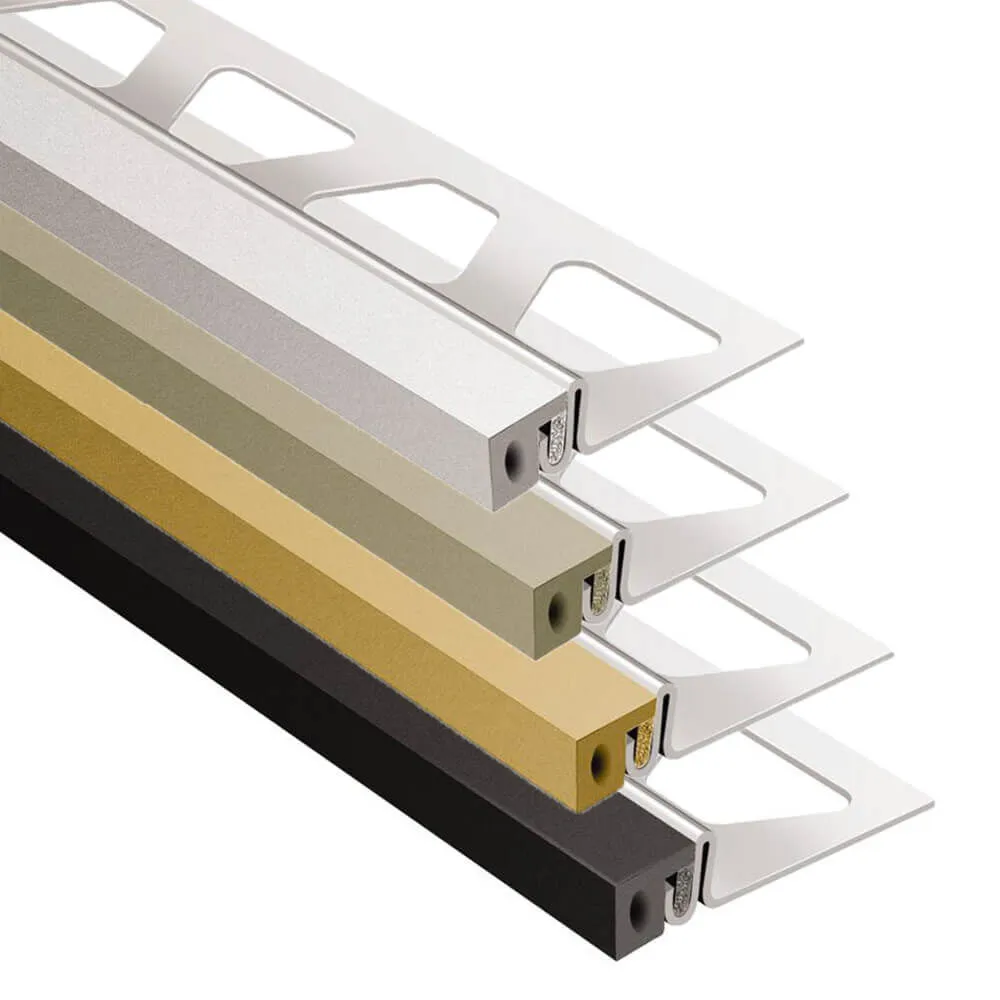
Schluter-DILEX-KSA is a perimeter joint profile with a stainless steel or aluminum anchoring leg and a 3/8” (10 mm)-wide, replaceable rubber movement zone that isolates the tile covering from fixed building elements.
Schluter-DILEX-KSA features a trapezoid-perforated anchoring leg, made of stainless steel or aluminum, which is secured in the mortar bond coat and provides edge protection for adjacent tiles, and a self-adhesive backing strip which can be bonded to fixed building elements (e.g., door and window frames, bathtubs and shower trays, countertops, etc.). The profile isolates the tile covering from the structure and accommodates movement via the 3/8″ (10 mm)-wide, soft thermoplastic rubber movement zone, which also forms the visible surface. The thermoplastic rubber movement zone can be replaced if damaged. DILEX-KSA uses the same anchoring leg as DILEX-KSN to allow for the same appearance throughout an installation. DILEX-KSA also prevents sound bridges, making it ideal for transitions in sound-rated floors.
Designed to allow movement and reduce stress in large, tiled areas
Eliminates the need for caulking
Prevents cracking and delamination of tiles
Ideal for applications such as window and door frames
Features a self-adhesive strip that allows it to bond to the fixed building elements
These profiles are V2A Stainless Steel
Installation
Schluter Edging Trim Installation
Select the profile according to tile thickness and format.
Using a notched trowel, apply thin-set mortar to the area where the profile is to be placed. If the JOLLY, QUADEC, RONDEC, RONDEC-DB, DECO-DE, FINEC, or FINECSQ profile is to be used as edging for an outside wall corner, finish tiling one wall first; then trowel thin-set mortar over the corner area of the second wall.
Press the perforated anchoring leg of the profile into the mortar and align.
Trowel additional thin-set mortar over the perforated anchoring leg to ensure full coverage and support of the tile edges.
Solidly embed the tiles so that the tiled surface is flush with the top of the profile; the profile should not be higher than the tiled surface, but rather up to approx. 1/32″ (1 mm) lower.
Set the tile to the integrated joint spacer, which ensures a uniform joint of 1/16″ – 1/8″ (1.5 – 3 mm). With the stainless steel profiles, leave a space of approximately 1/16″ – 1/8″ (1.5 – 3 mm).
Fill the joint completely with grout or setting material.
Work with materials and tools that will not scratch or damage sensitive surfaces. Setting materials must be removed immediately, especially from aluminum.
Note: Matching corners and connectors are available. Corners are held in place with thin-set mortar. Fill the ends of the profile with thin-set mortar prior to inserting the accessories. Connectors are held in place with a friction fit. Insert the connector into the profile approximately half the length of the connector piece and connect the adjacent profile.
How do I cut profiles?
Schluter™ profiles are available in a variety of different materials, so methods for cutting vary. Below are best practices for cutting according to material type.
Plastic
Plastic profiles may be cut using Schluter™-SNIPS or similar. It is important to make sure the blade is sharp in order to ensure a clean cut.
Aluminum
One option for cutting aluminum profiles is to simply use a hacksaw. Look for a bimetal blade and select the highest teeth per inch, or TPI, available. A miter box is recommended to help ensure a straight cut. Aluminum profiles may also be cut using a variable-speed angle grinder with the Schluter-PROCUT-TSM cutting wheel. Set the angle grinder to the lowest speed. A clamp or cutting jig can be used to secure the profile and help ensure a straight, clean cut. Finally, aluminum profiles can also be cut using a chop saw or miter saw with a non-ferrous blade. After cutting, make sure to remove any burs with a file before installation.
Brass
Brass profiles can be cut by using a hacksaw with a bimetal blade with the highest teeth per inch available, or by using a chop saw or miter saw with a non-ferrous blade. Removing any burrs from the cut end of the profile with a file (or similar) is also recommended.
Stainless Steel
The simplest option for cutting stainless steel is to use a variable-speed angle grinder with the Schluter-PROCUT-TSM cutting wheel. Set the angle grinder to the lowest speed. Another option for cutting stainless steel profiles is to use a band saw with a metal cutting blade. After cutting, make sure to remove any burs with a file before installation.\n\n
\n
| SKU | S DILEX KSA SS |
|---|---|
| Weight (lbs.) | 2.02 – 2.94 |
| Non-Returnable | No |
| Manufacturer | Schluter |
| Warranty | 5 Year Limited Warranty |
| Dimensions (L x W x H) | 8′ 2-1/2″ x 1-35/64″ x 23/64″ – 8′ 2-1/2″ x 1-31/64″ x 1-7/32″ |
| Trim Material | Stainless Steel/Thermoplastic |
| Trim Length | 8′ 2-1/2″ |